
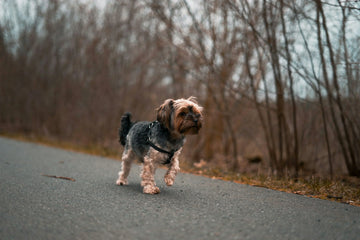
Seeing your dog limp can turn an ordinary walk into an urgent guessing game. The affected leg may be obvious, or your dog may simply shorten a stride, hesitate on stairs, or shift weight in a way that is hard to read. A limp tells you that normal use of a limb is being affected; it does not tell you the cause.
The safest response is to judge urgency first, reduce activity, and let a veterinarian identify where the problem is. A brace or lift harness may become useful later, but only when it matches the body area and the care plan.
Quick Answer
If your dog is limping, stop running, jumping, and rough play, then note whether the dog can bear weight and check the paw visually if safe. Contact your veterinarian if the limp persists, returns, worsens, or limits movement—even without crying or swelling. Seek urgent care for severe pain, major trauma, deformity, inability to use the limb, or inability to stand. Never give human pain relievers unless your veterinarian instructs you.
Dog limping on a front leg vs a back leg
Front- and back-leg limps can look similar, but the possible problem areas differ. A front-leg limp may begin in a nail or paw pad, wrist, elbow, shoulder, neck, soft tissue, bone, or nerve. A back-leg limp may involve the paw, hock, knee, hip, lower back, soft tissue, bone, or nerve.
Support designed for one area cannot automatically support another. Dogs also shift weight away from discomfort, making the affected leg easy to misidentify. Record a short video of natural movement instead of naming the injury yourself.
| What you notice | Front-leg pattern | Back-leg pattern | What it does not prove |
|---|---|---|---|
| Short stride or quick lift | Paw, wrist, elbow, shoulder, or neck may be involved | Paw, hock, knee, hip, or back may be involved | The injured structure |
| Paw barely touches down | Can reflect front-limb pain or weakness | Can reflect rear-limb pain or weakness | Sprain vs fracture vs nerve or ligament problem |
| No crying or swelling | Does not rule out a front-limb problem | Does not rule out a back-limb problem | That exercise is safe |
Use these observations to describe the limp, not diagnose it. The actual problem may be higher or lower than the place your dog licks.

Should you observe, call a vet, or seek urgent care?
| Action | When it may fit | What to do now |
|---|---|---|
| OBSERVE BRIEFLY | Very mild and short-lived; still weight-bearing and otherwise normal; no trauma, wound, swelling, deformity, or neurologic sign | Restrict activity, use leash-only toilet breaks, prevent jumping, and record a video. Call if it persists or returns. |
| CALL A VET | Continues, recurs, changes normal activity, or comes with tenderness, stiffness, licking, a paw problem, swelling, or appetite change | Ask when an exam is needed. Share onset, triggers, recent activity, injury, and medication history. |
| URGENT / EMERGENCY | Will not use the limb; severe or worsening pain; fracture, deformity, deep wound, major trauma, neck/back pain, dragging, knuckling, or inability to stand | Limit movement and contact urgent or emergency care. Do not straighten or repeatedly test the leg. |
Brief observation is not treatment. If you are unsure whether the dog is fully weight-bearing, call your clinic; medical history may change the recommended timing.
How to check a limping dog safely at home
Move your dog to a calm, non-slip area. Stop fetch, running, stairs, furniture jumping, and long walks. Use leash-only toilet breaks rather than asking the dog to “walk it off.” Do not risk dropping a large or unstable dog while moving them.
Watch without forcing extra laps. Note sudden versus gradual onset, changes after rest, and whether your dog can rise and turn. If safe, record 10 to 20 seconds of natural walking; excitement at the clinic can mask a subtle limp.
If handling is comfortable, look for a torn nail, pad damage, cut, material between the toes, or swelling. Compare sides visually, and stop if your dog pulls away or guards the limb. Pain can make a gentle dog bite.
Do not bend joints, press hard, massage, or apply a tight wrap or homemade splint. Report what you saw rather than trying to prove the location.
Do not give human pain relievers
Do not give ibuprofen, naproxen, acetaminophen, aspirin, or leftover medication unless your veterinarian directs you. A previous prescription may be wrong for a new problem or health situation. The FDA advises owners to call a veterinarian before using human or leftover pet pain medicine.
What if your dog is limping with no pain or swelling?
“Dog limping front leg no pain or swelling” and “dog limping back leg no pain” describe appearance, not a medical category. Dogs may keep eating, wagging, and asking to walk while changing how they load a limb.
Swelling may be absent, subtle, or hidden beneath fur. Paw, joint, soft-tissue, or nerve-related problems may not create an obvious lump. The limp itself deserves attention.
If a mild change fully resolves with quiet activity, watch for recurrence. Contact your veterinarian if it returns, affects stairs or rising, or remains into the next day. “No swelling” is not permission for a normal run.
Common cause categories by location
A paw or nail problem can affect any leg. Broken nails, pad damage, cuts, or material between the toes may cause a sudden limp. A visual check may find a surface issue, but punctures and painful nail-bed injuries still need veterinary guidance.
Higher on the limb, soft tissues, joints, bones, and nerves can produce lameness. Veterinarians may evaluate the wrist, elbow, shoulder, and neck for a front-leg limp, or the hock, knee, hip, and lower back for a back-leg limp. Age, activity, history, and onset narrow the list but do not confirm a diagnosis at home.
Repeated toe dragging, knuckling, crossing limbs, loss of balance, or weakness in several legs deserves prompt attention. A generic wrap cannot identify or correct a neurologic cause.
For ongoing rear-leg weakness, read the hind leg weakness in dogs guide. If a vet localizes the problem to the rear knee or cranial cruciate ligament, use the dog ACL and knee brace guide and torn ACL in dogs guide.
When is rest appropriate?
Short-term activity restriction can protect a mild limp while you seek advice: use leash-only toilet breaks, avoid running, rough play, jumping, and stairs, add traction, and keep essentials easy to reach.
Do not use rest to delay care. Refusal to bear weight, worsening pain, swelling, weakness, or other red flags need faster evaluation. A limp that returns with normal activity also deserves an exam.
After diagnosis, let your veterinarian set the restriction or recovery plan. Do not stretch, massage, or “strength test” the leg without instruction.
When to call a vet
Call when a limp lasts beyond a brief episode, recurs, or changes walking, sleep, appetite, stairs, or rising. Severe, sudden, or worsening limping needs faster assessment. Lameness can involve muscles, joints, bones, or the nervous system.
Seek urgent or emergency care for inability to use the limb or stand, obvious fracture or abnormal angle, major trauma, a deep wound, severe distress, neck/back pain, rapid coordination loss, repeated knuckling, or multi-limb weakness.
Bring a timeline, video, and medication history. The vet may examine the limb from toes upward, check the spine and nervous system, and recommend imaging. Accurate localization makes later care and support choices safer.
Why diagnosis comes before a brace or harness
A brace must match the affected area, fit without rubbing or restricting circulation, and align with the veterinary plan. A lower-leg sleeve cannot stabilize the shoulder or hip. It is not an ACL/CCL brace: the cranial cruciate ligament involves the rear knee, or stifle.

A lift harness assists part of the dog’s weight during a controlled transfer or short movement. It does not diagnose the limp, remove pain, or make pushing through an injury safe.
Ask three questions before considering equipment:
- Which limb and anatomical area did the veterinarian identify?
- Is external support or assisted lifting appropriate for this condition and stage?
- What fit, wear time, skin checks, and activity limits should you follow?
If the answers are unclear, pause the product decision.
Helpful Pawsbetter support options
After your vet identifies the affected area and approves external support, the dog leg brace collection can help compare support by location—not by the word “limping” alone.

For a front-limb plan, discuss the Dog Front Leg Support Harness Brace. For vet-directed lower-leg support, compare the Professional Dog Leg Support Brace. Never select a lower-leg brace as an ACL brace; rear-knee support is a separate decision.
For short, controlled lifting, discuss the Dog Leg Support Brace with Lift Strap or Dog Front Leg Lift Harness. Do not use them over a fracture, open wound, or severe undiagnosed pain.
For sustained mobility needs, read the lift harness vs dog wheelchair guide after assessment. Follow model-specific measuring instructions and stop use for rubbing, swelling, discoloration, colder toes, worse limping, or distress.
FAQ
Why is my dog limping on a front leg with no pain or swelling?
No crying or swelling does not prove the leg is pain-free. Restrict activity and call your vet if the limp persists, returns, worsens, or changes movement.
Should I worry if my dog is limping on a back leg but does not seem to be in pain?
Yes. Dogs may hide pain, and weakness can change limb use. Call if it lasts, recurs, or comes with stiffness, toe dragging, trouble rising, or reduced activity.
How long should I let my dog rest before calling a vet?
Only a mild, short-lived limp in a fully weight-bearing, otherwise normal dog is reasonable to observe briefly. Do not wait for non-use, worsening, trauma, or other red flags.
Can I give my dog a human pain reliever for limping?
No, unless your veterinarian specifically instructs you. Human drugs and leftover pet medication can be unsafe or inappropriate; call your clinic.
Can a dog leg brace help with limping?
A brace may support selected cases after the problem area is identified. Ask whether it is appropriate, which area needs support, and how it should fit.
Is a lower-leg brace the same as a dog ACL brace?
No. A general lower-leg wrap supports a different area. An ACL/CCL problem involves the rear knee and needs a knee-specific discussion.
Should I wrap or massage a limping leg at home?
Not without veterinary instruction. Tight wraps can affect circulation, while massage or forced movement can worsen pain or instability.


